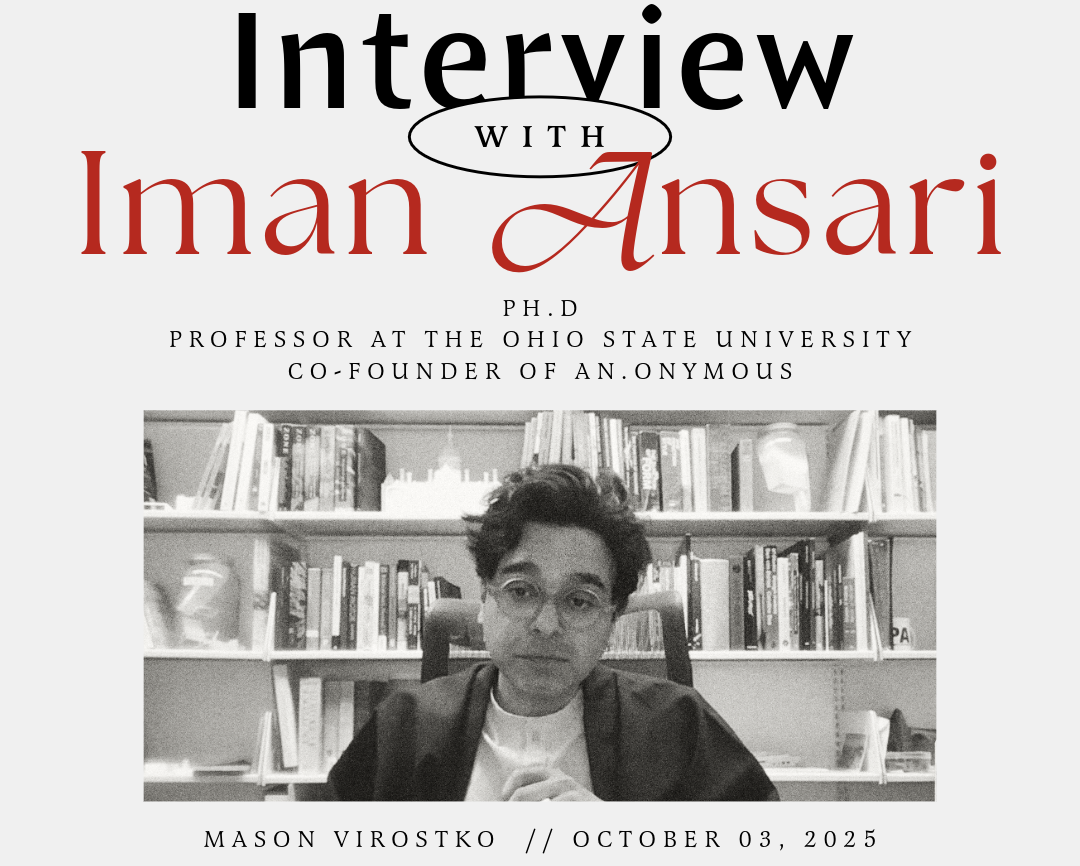
Mason Virostko: At the Future of Architecture and Building Conclave in 2024, you said that “design prescribes the very patterns of life” and that every time we rethink our design, we cause “disruption”. When our bodies are disrupted, they take time to heal, and they can only handle so much physical stress. The same goes for society and the planet. How can we make sure to redesign without causing too much disruption to our way of life?
Iman Ansari: That's a very good question. There are certain disruptions that are obviously not good or welcomed, but there are also some disruptions that are needed and good. I think the point is, yes, we do disrupt normal ways of life any time we design and do things differently. But at the same time, just like in any other field, we're also innovating when we disrupt. Any innovation has disrupted society. And of course, it takes time to adjust. But sometimes in the long run, that's much better than going with the status quo. I am one of those people who believe that disruptions are good, are needed, especially given how things have settled. If you think about it, modern life and architecture is a product of the 18th and 19th centuries. We work sitting behind a desk. We deal with writing and paper or nowadays screens. You know, we make food in designated places called kitchens. We sleep in a very specific way. We bathe in a very specific way. All of these are things that if you look at human history, have been around for at least 200,000 years. And if you look at this pattern of life that we're talking about, that is really just the product of 200-300 years. That's a blip in the larger, longer history of humans. What I am interested in is to show that in this pattern of life, architecture was a part of defining those things. Architecture was participating. It wasn't just that architecture was influenced by them, but architecture was a part of defining those ways of life. Those are what I call the very ingredients of modernity. What qualities make us modern humans? Paradigms of modernity. In the way we live now, we expect privacy. We expect good health. We expect comfort. These ingredients didn't exist as a right for everyone 200-300 years ago. They really became ingrained in our way of life recently, and architecture was a part of creating that. So not only going back to the roots to see how architecture can contribute to those, but also how we can disrupt those for better. Because whatever that pattern of life may have been, or how useful it may have been at the time, it's obviously not working. Our planet is dying. So it does require disruption. It does require innovation. It does require new ways of thinking. And it begins with architecture. As architects, we script those programs, those patterns of life. We are the directors of this movie. We're designers of this game we're playing in, because we are the ones who decide how people sleep, how they eat, how they bathe, how they work, what postures, gestures and behaviors they adopt. I think we can make a big impact by thinking or rethinking those aspects and coming up with better solutions, even if they may be disruptive.
MV: In “Field Notes on Design Activism: 5”, you said that “The world has turned, as it were, into an enormous hospital, with all of us on some form of life support.” As a believer in holistic medicine, this quote really resonated with me. What personal experiences have led you to this viewpoint, and how can you relate these experiences to your work?
IA: I grew up around a family of people who worked in the medical field. My mom was a nurse, my uncle is still a surgeon, and my sisters are both in the medical field. So I was a little bit exposed to that. And I was always interested in medicine, but I was interested in medicine because of its interaction with the human body. I thought that this was a shared interest in architecture and medicine. We both care about the body. Medicine cares about the internal workings of the body, whereas architecture deals more with the external behaviors and functions of the human body. Architects have long been interested in the body as a source of inspiration, whether through proportions, aesthetics, or functionalism. I was interested, as a student, in technology and machines. I became initially interested in prosthetics. For me, prosthetics were kind of these intermediary objects that are the boundaries between natural and artificial, biological and technological. I began to think of architecture as a prosthetic extension. Why aren't we, as architects, really thinking about architecture or the built environment as an extension of the body? I was interested in integrating technology into architecture and became more interested in intermediary objects like furniture and fixtures as a way to do that. If you think about it, we live and breathe every day inside buildings. But where do we actually touch and feel buildings directly with our bodies? You turn on the light switch, you turn a doorknob to open a door, or you sit on a chair and touch a table. You use the bathroom and sit on the toilet seat. Those are the moments where architecture and the body really come into contact. So I realized if I'm interested in the ways architecture interacts with the human body, I'm interested in the emergence of modernity as a paradigm, which comes at the birth of modern medicine itself in the United States. Medicine as a field was born in the mid-19th century. This was the same time architecture was established as a profession. That's why I became more interested in hospitals, as a way that not only connects architecture with the body, but also connects the two fields together. What I meant by that quote is that I’m trying to really highlight the gravity of the situation we're in today. And, to highlight the fact that much of what we're doing is just temporary life support systems to sustain us a little longer, rather than rethinking better, long-term solutions for how we might live and flourish on this planet.
MV: Right, it's like slapping a Band-Aid on it instead of solving the root of the issue. You talked about material culture and building technology being integral to rethinking how our world works. Could you give an example of where a material transformed the conceptual or spatial quality of your project?
IA: In academia, material culture doesn't just mean building materials, but it means objects, elements, devices, and things that function as an intermediary between humans and our environment. Material culture becomes a representation of the wider culture manifested in material forms. We designed the second building of the Northstar Medical Campus. In the staff bathroom, we did something new. When you go to every restaurant or medical facility, there's always this sign that says “employees must wash hands”. This is exactly the same thing we do in architecture because we program buildings. If you look at the floor plan, and one room says office, another says classroom, another says meditation room. But for the most part, with few exceptions other than the signage on the door, there's really no distinction in the way that the room is designed. It's just blank space that is programmed. Most of the time as architects we rely on narrative programming, which is basically describing things and hoping that people will just do that thing in that space. Whereas, architecture can also do active programing, which is to actually inscribe or enforce that behavior through physical, spatial, or material things. So if you look at the staff bathroom and it says “employees must wash hands,” that's a narrative program. Now, how do you translate that into an active program? To do so, we designed a bathroom with the toilet and the sink in the middle of the room facing a beautiful window with a nice view. The sink is connected to the toilet tank, meaning there's no water in the tank unless you wash your hands first. You have to wash your hands long enough for the water to fill up the tank. This was one way to translate that behavior to an active program that is enforced through architecture. The hope is that we can think of every positive behavior in the same way and rely less on narratives, descriptions, and tags. How can we cause better behavior, and how can we do it through active programming rather than narrative programming? This is disruptive, and some people may not like it, but it's a positive disruption in the long run.
MV: It sounds like active programming is about creating an experience for the user of the architecture. We don't see it as much nowadays. Architects no longer design every aspect of their buildings. As we get further into a late-stage capitalist society, do you believe that architecture can still act as a cultural avant-garde, or is it inevitably locked within market and politics?
IA: Yes, I think some modern architects do a ‘total work of art.’ That's how George Baird describes the CBS Building by Saarinen, and how he designed every aspect of the work. Those aspects were designed with real care and attention to the culture, values, materials and artistic expressions of buildings. At the same time, there were other architects who didn't, who cared less about architecture as a cultural expression, and were more interested in architecture as a practical, functional thing. A good example of that is Cedric Price, who came up with the idea of what he described as life conditioning, and what I'm talking about as active programming. He said that life, just like AC conditions the air, that architects condition life. He came under attack by architects, including George Baird, who trashed him for saying his work treats architecture as just utility, not form and culture. Since George Baird's attack on Price, we've had multiple things happen. We had Pruitt-Igoe. We've had constant misreadings of Michel Foucault. Social engineering projects of the 20th century when architects tried to solve social problems and failed. When I was in school, everybody read Michel Foucault, but everybody read it as a negative example of how powerful and dangerous architecture can be. But that wasn't really what Foucault was saying. It took me years to discover that what Foucault was saying was exactly the opposite. What he was saying is that yes, there is the subjugation, which is a negative form of biopower, but then there's also subjection or subject formation. In the panopticon, not only are inmates subjugated and feel less powerful, but they're also empowered to form their own identities and their own behaviors. What [Foucault] is describing is that biopower can be both positive and can be negative. In the past few decades, our field has mostly focused on the negative aspects of active programming or life conditioning and ignored the positive aspects. I love architecture. I teach architecture history. We look at styles and materials. That's obviously part of architecture and hopefully it will be part of architecture forever. We want to create buildings, spaces, and objects that are not just functional but also participate in cultural production. But at the same time, it looks like we've lost sight of the power of the practical aspects of our work. We don't even think about how our work impacts the way people move and behave in space. We stopped caring about it because we got too obsessed about physical appearance. To me, that's a huge problem. Personally, I'm quite bored of all the formal gymnastics. Since I've been in architecture school for the past 25 years, I've lived through computers and parametricism and I've seen numerous buildings that explore it. And I quite honestly, I just don't know what the end of that is. I mean, what else can we do with form? It's beautiful, but so what? I like to think as architects, our work means more than just aesthetic, formal or even just cultural production. I like to think that our work matters. I like to think that our work can change the world for the better. I actually think you can have big, grand ideas in very small things. I mean, the toilet was an example, right? And the doorknob is an example. The office chair is an example. We need more of that in architecture. It actually begins not by big grand gestures. It begins by paying closer attention to the seemingly small and insignificant objects and devices around us.
MV: Present day architecture is mostly built under a post-critical lens. When you think about people like Bjarke Ingels and the success that he has had under this lens, do you think we have evolved past the need for critical approaches to architecture?
IA: I have been thinking about that, because yes, I think we're in a post critical era, for better or worse. I think we do need to revive some of that critical framework within our discipline. We're a little bit, to some degree, subsumed by works that don't participate in that dialog, and I feel the absence of it. It's also the change in our environment. Nowadays, not many architecture students read every issue. We’re on our screens every day. Attention spans have shrunk. We consume information in very different ways than we did even in the 90s. So in reality, criticality in the way it existed back then cannot exist today. Number one, People are just not that way anymore. Number two, criticality emerged in a very unique time. The 90s was the golden era when architects could afford to be critical. It was a critical architecture that was primarily concerned with the baggage of philosophy and theory, which was immensely useful and productive to build our discourse. But we don't live in that world anymore. I wish we had a discourse around architecture today the way we did back then. Theory in general is seen to be weakening. And I think it's partly because we have much bigger problems thrown at us. Economic uncertainty has always been there, but it’s mostly culture, technology, and the environment. I think we need that same framework, but not the same focus as before. We need to be critical about other things in the same way, and with the same rigor. I feel like that is more important to reestablish [criticality] in the new digital era of an increasingly unstable planet.
MV: Where would you place your own work in this debate between criticality and post criticality?
IA: What do you define criticality and post-criticality as?
MV: I would say post-criticality is about things like pragmatism, flexibility, and collaboration with governments or corporations. It's about taking the world as it is, and having architecture exist within that realm. Criticality challenges the way our society functions. Maybe not to its core, but to an extent, past corporations and the powers in control.
IA: A lot of the stuff I do is not because I think it's a radical idea. I do it because I actually think that's what architecture is to me. Every architect ends up, through their life and career, defining architecture in a unique way for themselves. I'm still rethinking and redefining it as I go, and I've been doing it for a long time. I'm sure I'm going to. It's going to change as I go forward, but that's about exactly being critical. Maybe I'll answer that in a more personal way rather than trying to sound like a theorist or an intellectual. When I started architecture school, I was very excited about architecture. In the first year and a half, I learned all the basics. And to be honest, I got really bored. I was in a good program, but I felt like, “That's it? That's all we do?” It was missing something deeply meaningful for me. And it wasn't critical. I started taking philosophy courses, and then I ended up switching my major from architecture to philosophy. I still kept registering for studios because I wanted to get my degree in architecture, too, and I didn’t want to jump ship yet. What I value in philosophy is this idea of constantly questioning things because historically, all fields were philosophy. And as we figured out how certain things work, like physics or astronomy, they moved out of philosophy. So philosophy was left with just the basic questions: Who are we? Where do we come from? What's the point of all this? And what happens after we die? And these are the questions that we still don't have answers for. And because we don't have answers to philosophy, it is not about answers. It's really about questions. So, that idea of criticality is built into philosophy. How do we know our theories or hypotheses are right? How can we validate it? So again, it’s this constant feedback loop of questioning and theorizing. That's what really drew me to philosophy. It was about that way of thinking and formulating ideas and then being able to question and validate them. I felt like architecture didn't have that, which is why until I graduated, I kept switching majors every semester because I couldn't have a dual major. I had to switch back and forth. That's why I became interested in architectural theory later and so forth. To answer your question, I would like to be in the very critical debate. I would like to be the disruptor. Just because I don't really think, for the most part, what I see happening in architecture is going in the right direction. Now, I see things that are [post-critical], and I appreciate that. I love the work of many of my colleagues, architects, and educators. I'm glad that there are people who do things that are not the same things I do. That's what makes architecture great. So I'm not in any way saying everybody should just become me and do work like I do. But at the same time, I feel like [architecture] could be at least moved into a better direction. A direction that is conscious about the current state of our environment. [In our current world,] AI is seen as a disruptor. It changes the way we've been doing things. [...]Computers were seen as disruptors when they emerged. The thing happened before with the invention of the printing press. So I feel like these are disruptions that deserve our attention and we need to use it. Even if in the beginning we are misusing these technologies, even if we are making mistakes. Even if you do a project that is disruptive and it fails, at least you tried. Next time, do better. But ignoring all this and pretending that everything is fine and we still live in the 90s is just a disservice to us. I just want to add this as a footnote: As architects, our education is so amazing. We learn history, we learn theory, we learn structures, we learn technical things, and we learn humanities. We have such a well-rounded education that is meant to prepare us to be leaders. I feel like we're not utilizing both the power of our education, and the power of what architecture is and has been historically, especially in a time like this where it's most needed.
MV: Why is it important to teach architectural theory to students who are not interested in becoming theorists?
IA: Because without theory we don't have architecture. Because theory gives us the basic framework to think and to generate ideas, to formulate positions, and to situate our work in relation to others. In engineering or in medicine, students don't have to take history or theory courses, right? Why is that? I think the answer is because they're concerned about primarily solving problems and finding the most efficient way to do so. That's part of our work, but architecture is also a cultural discourse. We have an impact on the broader culture. Our work is always viewed in conversation with other works, whether it's in the context of just the city that literally sits amongst the buildings or in the context of discourse itself. To know the history and to know theoretical frameworks that are around us would help us better position ourselves to produce work that contributes and hopefully expands our field and its impact. I like my students to be first and foremost thinkers before they are designers or builders. I think theory is still necessary, despite what we've witnessed in the past two decades or so. The way I teach theory is a little bit different,[...] I try to integrate contemporary theoretical problems[...]. I try to tie it to issues that are emerging, from climate to computation to AI to the political environments we live in. I think that's what contemporary theory is really about. It provides us a space within academia to really discuss, debate and think through it.
MV: How important is it, as an architect, to attain expertise across multiple disciplines?
IA: I was just giving a lecture two weeks ago about Vitruvius. When you read the textbook that the students have, it says Vitruvius was a Roman architect, an engineer. But in reality, the distinction between an architect and an engineer, or even a builder, was not really there 2000 years ago. A lot of these categories, whether professional or disciplinary, emerged in the 18th, 19th, and 20th centuries. So before the past few hundred years, they didn't exist. There was no real distinction. So why do we have it? Is it useful? Yes, it's useful because expertise and knowledge in these fields grew so much that it's just impossible to do multiple things right. As you may know, there are not many PhDs who are also practitioners because that's considered to be the two different fields. And it's deemed impossible to do both effectively. I think we also lost sight of the fact that these things are arbitrary categories that are just designed to increase productivity. And there's nothing inherent in that. As much as I respect the disciplinary boundaries and the expertise we have in each field, I think we have to respect that and rely on that. When we do research or creative work, don't work across from [other disciplines]. [Instead,] reach through to them to be able to innovate. Otherwise, we're going to be even less relevant than we have already become and innovate even less than we are doing now. Those things will not cause any disruptions to our way of life. We will just work in perfecting smaller and smaller areas and improving smaller and smaller things. I mean, I design, I build buildings, and to me, it's astonishing that I have to draw the plans and drawings, send it to the engineers, and then they draw their stuff over mine and send it back. There's really no conversation with us around the table to say, “Hey, can we design this pipe to do this?” Now we want to do this toilet [in the Northstar Medical Campus], they're saying it's impossible because they have to actually sit down and solve it. This is the problem. So we need more disruptions and more conversations in order to innovate and come up with a better solution. After COVID, I thought we were going to rethink heating and ventilation in buildings which are outdated and not effective. And yet, everybody was just avoiding the indoors and not thinking, “Hey, let's rethink ventilation in buildings.” No one questioned it. No architect or engineer said, “It's actually our fault because we designed cross ventilation and it basically carries germs and diseases across everyone.” No one started to think, “Maybe we rethink this because in the next pandemic, we can avoid that problem.” But nowadays everybody just wants to keep doing what they've been doing. And that’s fine, but I can't do that.
MV: When architecture was first extensively studied by the ancient Greeks, those architects were much more than just architects. They were also poets and mathematicians and philosophers. They studied all aspects of life. I think we have lost that. As you said, productivity has been the focus. As a result, our focus as architects has narrowed.
IA: But you see, I don't think we can have that anymore. It's just simply too much expertise, too much knowledge. [For example,] the fact that no one in Apple knows how to put this iPhone together because there's so much expertise and there's no one person that knows all of it. It's the same with buildings. It's the same with everything. So I don't think we can have that anymore simply because expertise and knowledge has grown so much that it doesn't fit inside our brain. That being said, I think we need the expertise, in fact, more so than ever. I think what we can do is talk to each other more, and that's easy. And that's what others do. That's what Apple engineers and designers do, they go and talk to each other and brainstorm solutions together, whereas we are in our disciplinary silos. In many schools, we don't even talk across our hall to other departments, let alone walk across campus to sit down with an engineer or a philosopher and discuss things. So I think that’s something we can do and that we need to do more. My advisor, Sylvia Lavin, used to say: there are things you can do when you're seated, and then there are things you can do when you’re not. There is only so much you can do at your desk and behind your screen, and you can exhaust all of that. At some point you have to get up and go talk to someone. Go to the library, go to the archive, go visit a site. And I think that's the challenge we have now: To get up and get off our seats.